Showing posts with label Direct Extrusion. Show all posts

Monday, June 5, 2017

Direct extrusion

Extrusion is a compressive deformation process in which a block of metal is squeezed through an orifice or die opening in order to obtain a reduction in diameter and increase in length of the metal block. The resultant product will have the desired cross-section. Extrusion involves forming of axisymmetric parts. Dies of circular on non-circular cross-section are used for extrusion. Generally, extrusion involves greater forming forces. Large hydrostatic stress in extrusion helps in the process by enhancing the ductility of the material. Metals like aluminium, which are easily workable, can be extruded at room temperature. Other difficult to work metals are usually hot extruded or warm extruded. Both circular and non circular parts can be obtained by extrusion. Channels, angles, rods, window frames, door frames, tubes, aluminium fins are some of the extruded parts.
Direct extrusion


Direct extrusion:

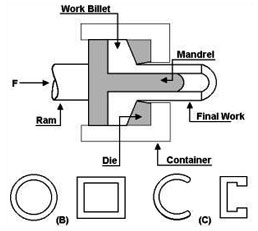
Direct extrusion, also called forward extrusion, is a process in which is the billet moves along the same direction as the ram and punch do. Sliding of billet is against stationary container wall.Friction between the container and billet is high. As a result, greater forces are required. A dummy block of slightly lower diameter than the billet diameter is used in order to prevent oxidation of the billet in hot extrusion. Hollow sections like tubes can be extruded by direct method, by using hollow billet and a mandrel attached to the dummy block.

Extrusion force, which is the force required for extrusion, in direct extrusion, varies with ram travel as shown in figure above. Initially the billet gets compressed to the size of container, before getting extruded. Also, initially static friction exists between billet and container. As a result the extrusion pressure or force increases steeply as shown. Once the billet starts getting extruded, it length inside the container is reduced. Friction between billet and container now starts reducing. Therefore, extrusion pressure reduces. The highest pressure at which extrusion starts is called breakthrough pressure. At the end of the extrusion, the small amount of material left in the container gets pulled into the die, making the billet hollow at centre. This is called pipe. Beyond pipe formation, the extrusion pressure rapidly increases, as the small size billet present offers higher resistance. As the length of the billet is increased, the corresponding extrusion pressure is also higher because of friction between container and billet. Therefore, billet lengths beyond 5 times the diameter are not preferred in direct extrusion.

Direct extrusion can be employed for extruding solid circular or non-circular sections, hollow sections such as tubes or cups.

Thursday, April 13, 2017

Direct Extrusion And Indirect Extrusion

Direct ExtrusionDirect extrusion is also called forward extrusion and it is the most general extrusion process. Its work operation includes the placement of the billet in a container, which is heavily walled. Ram or screw is used to push the billet through the die. In between the billet and ram, there is a dummy block, which is reusable and is used for keeping them separated.

Disadvantages of Direct Extrusion
One of the major disadvantages of the direct extrusion process is that the force needed for the extrusion of billet is more than what is required in the indirect extrusion process. This is because of the introduction of frictional forces due to the requirement for the billet to move the container's entire length. Hence, greatest force is required at the start of the process, which decreases slowly with the use up of billet. At the billet's end, the force is largely increased as the billet is thin and the material has to flow radially for existing the die. For this reason, the butt end of the billet is not used.

Indirect Extrusion
Indirect extrusion is also called backwards extrusion and in this process, the die is constant whereas the billet & container move together. To keep the die stationary, a “stem” is used which must be longer than the length of container. The final and maximum extrusion length is decided by the stem's column strength.As the billet movement is along with the container, all the frictional forces are easily eliminated. This results in following advantages:
  • 25 to 30% reduction of friction, allowing extrusion of larger billets, enhanced speed, and an increased ability to extrude smaller cross-sections
  • Less tendency for extrusions to crack as no heat formation takes place from friction
  • Container liner lasts longer, due to less wear
  • Indirect ExtrusionMore uniform use of billet ensures that extrusion defects & coarse grained peripherals zones are less likely
Disadvantages of Indirect Extrusion
There are a couple of disadvantages of the indirect or backward extrusion. This process is not as versatile as the process of direct extrusions, as the cross-sectional area is confined by the stem's maximum size. Also, the defects and impurities on the billet's surface affect the extrusion's surface. These defects destroys the piece, if it requires to be anodized or if its aesthetics are important. To eliminate this, the billets have to be wired brushed, chemically cleaned or machined before being used.